
Golf Buggy Insurance: Simple, Affordable Cover with Rubber Ring
Robert Jones
February 10, 2026
・ 2 min

There are few things more frustrating for a golfer than discovering a cracked driver, a broken shaft or damage to an expensive set of irons. Golf clubs aren't cheap, and replacing a damaged club can leave you facing an unexpected bill of several hundred pounds.
But what happens if you accidentally damage your golf clubs? Will your insurance pay for repairs or replacements?
The good news is that specialist golf insurance can cover accidental damage to your golf clubs, including damage that happens while playing, practising or transporting your equipment. However, exactly what's covered depends on your policy.
Here's what every golfer should know.
Golf clubs are designed to withstand considerable force, but accidents happen. Even experienced golfers can find themselves dealing with damaged equipment.
Some common examples include:
Whether an insurer will pay for repairs or replacement depends on the circumstances of the damage and the terms of the policy.
For example, an accidental impact may be covered, whereas damage resulting from gradual deterioration, normal wear and tear or an existing defect may not be.
That's why it's important to understand the difference between accidental damage and everyday equipment failure.
A cracked driver is one of the more expensive problems a golfer can encounter, particularly if you've invested in a premium model.
Modern drivers can cost several hundred pounds, so replacing one unexpectedly isn't particularly appealing.
If your driver cracks because of an insured accidental event, a specialist golf insurance policy may cover the cost of repairing or replacing it.
However, not every cracked driver will automatically qualify for a claim.
If the crack develops because of a manufacturing defect, gradual deterioration or ordinary wear and tear, the damage may fall outside your insurance cover.
In these circumstances, it's also worth checking whether your driver is still covered by the manufacturer's warranty.
The important distinction is how the damage happened, rather than simply whether the club is broken.
A broken shaft can turn a perfectly good golf club into something that's impossible to use.
Whether it's a graphite driver shaft or a steel iron shaft, the cost of replacement can quickly add up, especially with custom-fitted equipment.
Specialist golf insurance can provide protection against accidental shaft damage, subject to the policy's terms and exclusions.
For example, if you accidentally strike an object during your swing and break the shaft, you may have a valid claim.
On the other hand, a shaft that fails through normal usage, age or an inherent defect may not be covered.
If the club can be repaired, the insurer may consider repair rather than replacing the entire club.
This is one of the most important things to understand when insuring your golf equipment.
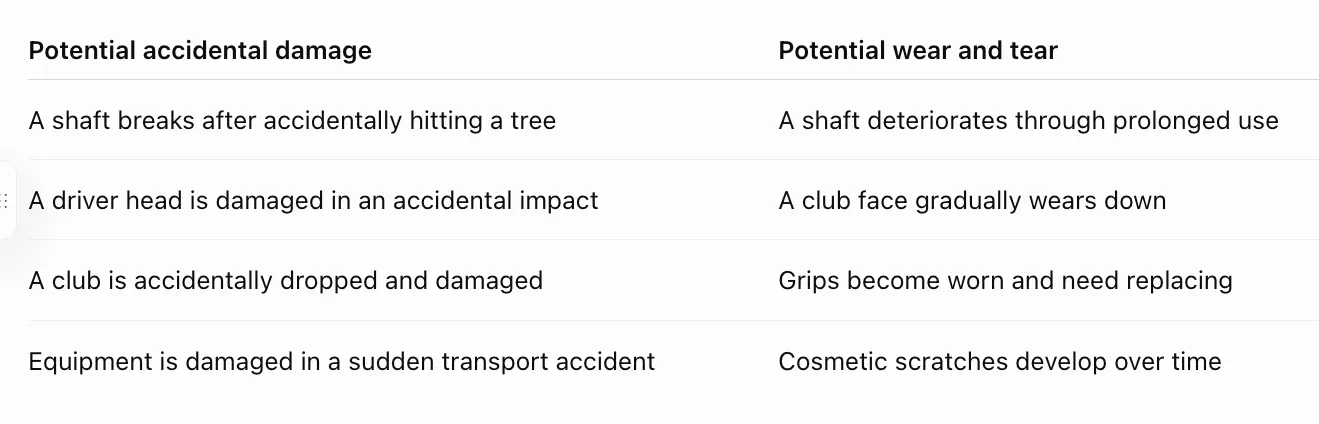
Accidental damage generally refers to sudden, unexpected physical damage caused by an identifiable event.
Wear and tear describes deterioration that happens gradually through normal use.
For example:
Golf Buggy Insurance: Simple, Affordable Cover with Rubber Ring
Robert Jones
February 10, 2026
・ 2 min